Residential Tile Installation in Chicago, IL
Substrate, layout, setting material and finish: the method follows the room.
Residential tile installation in Chicago calls for more than a tile choice and a trowel. At Tile Installation Normandy Villas, we plan the assembly beneath the finish as carefully as the visible pattern, whether the work is in a bungalow, two-flat, condominium, or a newer home. The review covers the existing substrate, moisture exposure, transitions, movement, heating systems, and the way the room will actually be used.
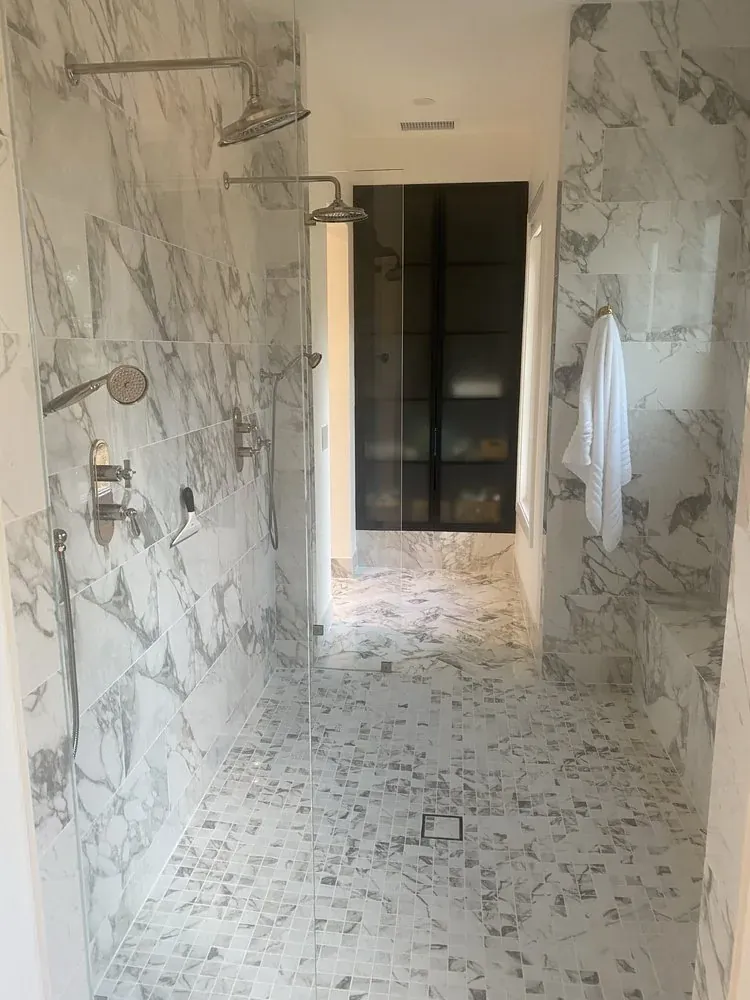
A system, not just a surface.
| Support | Sound slab or adequately designed joist/subfloor system |
|---|---|
| Surface | Compatible backer or prepared substrate, appropriately flat |
| Membrane | Uncoupling or waterproofing where the assembly requires it |
| Setting material | Mortar selected for substrate, tile and conditions |
| Tile | Product appropriate to use, format and load |
| Joint / grout | Grout for tile joints; flexible material at movement joints |
How the work goes
Assess the room and substrate
We begin with measurements, photographs, elevations, and a conversation about use, maintenance, and adjacent finishes. On an older Chicago bungalow or two-flat, we look for deflection, uneven joists, loose layers, cracked areas, moisture, and unknown adhesives or coatings. We discuss removal controls before disturbing older materials; testing or qualified environmental guidance may be appropriate when the material history is unclear. A backer board cannot stiffen an unsound floor, so movement and structural concerns are addressed before surface preparation.
Set the tile and water-management plan
We map the layout around walls, cabinets, drains, doorways, thresholds, and visible focal lines. For showers, the plan includes a compatible waterproofing assembly with a pan, corners, niche, bench when specified, drain, and sealed penetrations. Tile and grout are not waterproof by themselves. We distinguish a waterproofing layer from an uncoupling membrane: they can serve different purposes and should not be treated as interchangeable. For a heated floor, we coordinate the heating mat or cable, sensor location, controls, insulation assumptions, and finish height before ordering materials.
Remove and prepare safely
Removal may involve tile, thinset, old adhesive, underlayment, or damaged gypsum and cementitious materials. We use dust-reduction practices appropriate to the work area, protect paths and nearby finishes, and identify surprises rather than burying them. The prepared surface must be clean, sound, and sufficiently flat. Depending on the assembly, preparation can include patching, grinding, primer, localized repair, or a compatible leveling product. Cement board provides a suitable tile surface when correctly installed; it does not replace structural repair or a waterproofing system.
Build and install the assembly
We select compatible thinset and follow the requirements of the tile, substrate, membrane, and environment. Coverage is checked rather than assumed: large-format floor tile usually calls for careful mortar coverage, directional troweling, and back-buttering where appropriate. We manage lippage with a flat substrate, a sensible layout, consistent joints, and careful setting technique; a leveling clip system can assist but cannot correct a wavy floor. Movement joints and perimeter gaps are maintained where the assembly requires them. Shower components, corners, niches, benches, drains, and penetrations are detailed as one water-management system.
Grout, review, and hand over
After the installation reaches the required cure stage, we grout with joint width, exposure, color, and cleaning needs in mind. The completed work is reviewed for alignment, transitions, coverage-sensitive areas, finish quality, and drainage. Stone may require a sealer, while some porcelain and ceramic surfaces do not; sealing is material-specific and does not make a tiled assembly waterproof. We explain cure times, cleaning methods, entry protection, and any care steps that are specific to the selected tile and grout.
Materials & surfaces
| Material | Floors | Walls | Showers | Outdoor-rated |
|---|---|---|---|---|
| Ceramic | ■ | ■ | ■ | Product-rated |
| Porcelain | ■ | ■ | ■ | Product-rated |
| Large-format porcelain | ■ | ■ | Wall / floor-rated | Product-rated |
| Natural stone | Stone-specific | ■ | Stone-specific | Stone / climate-specific |
| Mosaic | Floor-rated | ■ | Floor / wet-rated | Product-rated |
| Glass | Floor-rated only | ■ | Wet-rated | Product-rated |
■ = potentially suitable when the specific product is rated for that use. Tile category alone does not establish slip resistance, freeze–thaw suitability or wet-area safety. Glass and natural stone need material-specific setting guidance.
Heated floors and Chicago’s older housing
Heated floors are planned as a complete floor assembly, not added after tile decisions are finished. We review available electrical capacity and control location with the appropriate trade, then account for mat or cable height, sensor placement, movement accommodation, thinset compatibility, and the manufacturer’s installation requirements. The floor still needs adequate support and flatness; heat does not correct deflection, and extra heat does not compensate for poor coverage.
Older bungalows and two-flats can contain multiple flooring layers and transitions that have changed over decades. We identify high and low areas, loose boards, patched sections, and edge conditions before setting tile. The goal is a stable, reasonably flat plane that allows consistent mortar contact and controlled finished elevations at doors and adjoining rooms.
Showers, entries, and hard-working surfaces
A shower receives special attention at the pan, drain, corners, niche, bench, valve, showerhead, and every pipe or fastener penetration. We use a compatible waterproofing approach and keep the tile, grout, thinset, and membrane roles distinct. The visible grout line is a finish joint, not the water barrier. For entries and mudroom-like areas, we consider salt, grit, wet footwear, cleaning access, and slip resistance along with appearance. A texture that improves traction can require more deliberate cleaning, so maintenance belongs in the selection conversation.
Aftercare & maintenance
Keep newly tiled areas protected from traffic, impact, standing water, and heavy cleaning until the specified cure periods have passed. Once in service, use a soft broom or vacuum for Illinois winter salt and grit, then clean with a compatible neutral product; abrasive powders and harsh chemicals can dull finishes or affect grout. Keep shower corners, joints, and drain areas free of buildup and report movement, cracking, hollow-sounding changes, or persistent moisture promptly. Dry indoor air during the heating season can make some wood-framed assemblies move, so normal seasonal observation is useful. Stone sealing varies by stone, finish, and product; follow the selected sealer’s directions rather than assuming every tile needs sealing. Do not use grout or a sealer as a substitute for repairing a leak or failed waterproofing.
Pricing factors
Residential tile installation is scoped from the actual assembly and site conditions. The proposal can account for:
- Room dimensions, layout complexity, cuts, patterns, borders, transitions, and finished-height coordination.
- Tile type, format, thickness, surface texture, stone characteristics, trim, and grout requirements.
- Existing substrate condition, deflection, flatness, patching, leveling, underlayment, membranes, and movement accommodation.
- Removal of tile, thinset, old adhesives, multiple layers, debris handling, dust controls, and protection of occupied areas.
- Shower pan, drain, niche, bench, penetrations, waterproofing details, and flood-test or cure sequencing where applicable.
- Heated-floor components, control and sensor coordination, electrical-trade requirements, and changes in finished elevation.
- Access, parking and carrying distance, furniture or appliance handling, occupied-home scheduling, and coordination with other trades.
- Substrate or material conditions that are concealed until removal, including unknown products that may need testing or specialized handling.
- Required cure time, return visits, sealing when appropriate, transition work, and the cleaning or protection plan.
These factors are reviewed before the installation plan is finalized so the scope reflects the room that is actually present.
Areas we serve
Chicago and nearby communities. We confirm access, scheduling and service availability with your request.
Frequently asked questions
Practical answers before the first tile is set.
Can tile be installed over an uneven Chicago bungalow floor?
It depends on why the floor is uneven and how much movement it has. We assess deflection, framing, loose layers, and surface flatness first. Localized patching or a compatible leveling method may help, but leveling compound or backer board cannot correct an unsound structure. Large-format tile generally needs tighter flatness control than smaller tile.
Is cement board waterproof?
No. Cement board can provide a suitable tile substrate when installed correctly, but it is not automatically a waterproofing system. In a shower, the pan, walls, corners, niches, benches, drains, and penetrations need a compatible water-management design. Tile and grout are not waterproof on their own.
What is the difference between uncoupling and waterproofing?
An uncoupling membrane is intended to manage certain stresses between a substrate and tile. A waterproofing membrane is intended to control water. Some products are designed for more than one function, but the product instructions and complete assembly determine what it can do; one should not be assumed to replace the other.
How do you handle a shower niche, bench, or drain?
They are planned with the shower’s waterproofing assembly, slope, tile layout, and finished elevations. We detail corners and penetrations carefully and keep the drain and pan compatible with the selected system. A bench or niche is not treated as a decorative opening cut into an otherwise unrelated wall.
Does every tile or grout need to be sealed?
No. Sealing depends on the material, porosity, finish, grout type, and product directions. Many porcelain and ceramic tiles do not need a penetrating sealer, while some natural stones do. Sealer can help with maintenance in suitable applications, but it does not waterproof a shower or repair a leak.
How long before a new floor or shower can be used?
Timing depends on the mortar, grout, membranes, substrate, temperature, humidity, tile, and scope. We provide area-specific cure and protection instructions at handover. Avoid moving furniture, washing the surface, or using a shower before the required stages are complete; premature traffic or moisture can compromise an otherwise careful installation.
Let’s define the next step.
Tell us the room, the size and the tile. We reply within 1 business day.
Related projects
| Project | Room | Tile appearance | View |
|---|---|---|---|
| Green Vertical-Tile Shower with Pebble Floor | Shower | Deep neutral with warm metal contrast | |
| Marble-Look Shower with Mixed Pebble Mosaic | Shower | Bright veined contrast | |
| Veined-Tile Primary Bath with Freestanding Tub | Primary bathroom | High-contrast contemporary |